

TYPICALLY, NICOLAS DI FELICE, the 42-year-old Belgian designer of the French fashion house Courrèges, wakes up around 7 a.m. This morning, on what feels like the first Monday of spring in Paris’s 19th Arrondissement, his alarm went off earlier, an hour or so before dawn. It’s two days until the brand’s fall 2026 runway show and he wanted to get in a head-clearing walk with his Dutch-born partner and close collaborator, Roderick Buijs, 35, Courrèges’ head of creative. In the hilly Parc des Buttes-Chaumont near the couple’s apartment, the bare magnolia trees have sprouted tiny buds seemingly overnight. Di Felice, who has a light mustache and an effortlessly warm demeanor, looks serene, if slightly tired — he stayed at the atelier past midnight last night while his team finished the embroidery of a Paris Métro ticket-patterned organza skirt. He likes that while the park may seem orderly — “very structured, very codified,” he says — it’s still wild enough that you can get lost in it. But this is not a day for wandering. “I can’t wait to get to work and start the fittings,” he says with a boyish smile, kicking up one leg and extinguishing a cigarette with the heel of his black leather boot.
The show, to be set in Le Carreau du Temple, a renovated 19th-century market hall in the Marais, will mark five years since Di Felice’s debut collection as Courrèges’s artistic director. Designed to chart a day in the life of the Parisian Courrèges woman — a force of nature dashing around the city in a minimalist armor of vinyl, jersey, mesh, leather and cleanly framed nude skin — this presentation will also mirror the real-world success of Di Felice’s revival of the Pop, space-age label, which was founded in 1961 by André Courrèges and his wife, Coqueline. “Almost every day in Paris, I see someone in Courrèges, and nothing makes me happier,” says Di Felice, who can take credit for bringing back the brand’s original monogram, which is now a prerequisite for a certain ultra-polished yet sensual, party-ready French uniform. He’s also overseen the opening of two boutiques in town as well as outposts in New York; Costa Mesa, Calif.; and Seoul.
At another fitting the day before the show, in a mirror-lined room in the brand’s headquarters off the Champs-Élysées, late-’90s club house tracks play as Di Felice pins a slinky look on the French model Jeanne Cadieu, 30. Hanging from the racks are the sort of geometric dresses, flared high-waisted coats and improbably tall boots that have become renewed Courrèges signatures. So has an edginess borrowed from rave culture, kink and biker aesthetics: In recent seasons, Di Felice has sent models out into his immaculate white cube sets with their eyes covered by blindfoldlike sunglasses while others strutted with a hand slipped suggestively inside a low-slung pocket. Toward the end of the fitting, Di Felice takes on the role of (temporary) tattoo artist, testing out a Courrèges logo on Cadieu’s shoulder.
UPON ARRIVING AT Le Carreau du Temple, guests hear the ticktock of a clock’s second hand pulsing through the speakers, and see a narrow runway meant to echo a city street. “This show is quite different because it isn’t a big white square. Instead, you see a woman walking in a straight line, like in a long continuous shot by Chantal Akerman,” Di Felice says, recalling the Belgian director’s 1974 black-and-white film “Je Tu Il Elle,” which follows a young isolated woman with near-real-time pacing. “Some people think that kind of thing is totally boring, but I find it incredible.”
Just before the procession begins, Di Felice takes a moment with each of the models lined up backstage. He hasn’t slept more than a few hours, on account of last-minute fittings and an issue with the faux-asphalt set flooring that required a motorcycle taxi trip back to the venue for his approval. “It was intense,” he says. “But everything looks like it’s supposed to now.” There’s an excited, impatient energy in the air as he makes his way to the front and Buijs hooks a few key rings onto bags. As the first of the models steps out onto the runway draped in a strapless white dress reminiscent of a bedsheet, the beeping of a digital alarm morphs into a French radio broadcast and then the clatter of the Métro. Day turns to night in a matter of minutes, as a confident rush of sharply tailored ensembles gives way to designs with cutouts and those that float and flutter around the body. The show concludes with a graphic finale that reprises all of the previously shown looks in pure white — a move inspired by an archival image of a Courrèges procession staged in 1980, when over a hundred models clad in white paraded through the city’s Place Georges-Pompidou.
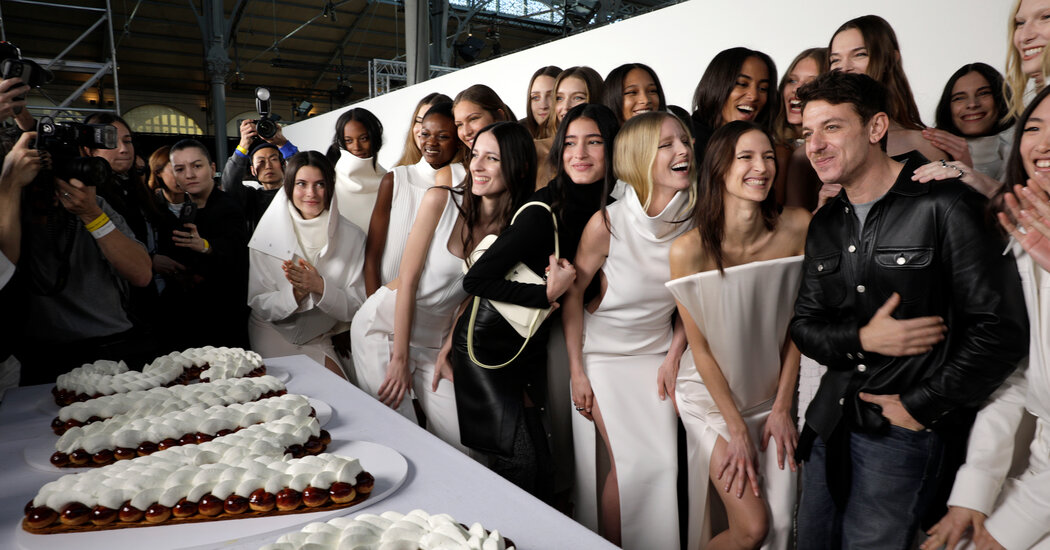
After a quick bow, Di Felice turns the corner as a series of enormous Saint Honoré cakes spelling out “5 ANS” in caramel-glazed choux are wheeled out to whoops and applause from his friends and longtime collaborators, many of whom are teary-eyed. When someone asks him about the best gift he’s received for his Courrèges anniversary, he answers without hesitation: “To be supported by such great people.”
Monday, March 2, 8:34 A.M.
Lush Life
Di Felice and his partner, Roderick Buijs (left), who first met while working together at Louis Vuitton over a decade ago, walk in the Parc des Buttes-Chaumont. The path overlooks a man-made lake built over an old gypsum quarry.
Tuesday, March 3, 12:17 P.M.
Tickets, Please
The designer’s ready-to-wear pieces are often as rigorously constructed as they are subversive. Here, the seamstress Simone Hoffmann finishes the last details on a skirt layered with hundreds of silken coat-check tickets all labeled with the number 40, a nod to the address of the Courrèges offices and flagship boutique on Rue Francois 1er. Elsewhere in the collection, an acid-yellow sheath dress plays on the concept with imaginary coat-check tickets for Courrèges Club, the name of the brand’s raucous fashion week parties typically held in empty lots on the outskirts of the city.
Tuesday, March 3, 12:51 P.M.
Walking the Walk
Cadieu wears a dark reinterpretation of a playful, square-shaped minidress from the house’s landmark 1965 collection, called “la bombe Courrèges” in the press at the time. “This is the final dress of the show: She goes home, she slips back under the sheets — alone or with someone, we don’t know,” Di Felice says of the new version.
Tuesday, March 3, 3:05 P.M.
Street Smarts
In the show venue, Le Carreau du Temple, a model tests out the runway, which was created over the course of about a week out of multiple coats of a black-tinted plaster mix layered over wooden flooring. Meant to conjure a Parisian street, it includes trompe l’oeil cobblestones and Courrèges-branded manhole covers.
Tuesday, March 3, 3:05 P.M.
Surface Level
Team members working on the floor. When Di Felice first saw the finished product, he thought it appeared rougher than what he and the show’s scenographer, Remy Brière, originally envisioned, so it was smoothed out overnight.
Wednesday, March 4, 7:50 A.M.
Behind the Scenes
“The vision for today is a woman in a hurry,” says the British hairstylist Anthony Turner (above left, at center), who, like Di Felice himself, is a self-proclaimed former club kid. Turner and the rest of the hair and makeup teams, including the assistant hairstylist Kaïzy Babo (pictured at right), set up on the building’s below-ground level. During the show, he stationed himself near the entrance to the runway, where he carefully tousled the models’ hair or tucked strands inside their high coat collars: “Some bits are going to be trapped in. Some are going to be pulled out.”
Wednesday, March 4, 8:48 A.M.
On the Beat
Models, some of them in their own clothes, rehearse to the show’s soundtrack, produced by Di Felice and his longtime friend and collaborator the Paris-based artist and musician Erwan Sene. “For two months, I always had a microphone on me,” says Sene, who recorded everything from his coffee machine to the walk down the steps of his local Belleville Métro station. The track also includes electronic dance music — the backdrop to almost all of Di Felice’s life. He grew up in the ’80s and ’90s amid the rural-industrial clash of the southern Belgian countryside, and started listening to new beat, a genre incorporating EBM and new wave, in kindergarten.
Wednesday, March 4, 10:30 A.M.
Picture Perfect
This season, Di Felice took inspiration from Paris’s magnetic-stripe paper Métro ticket, which was introduced in the 1970s and phased out of use this past November. Sparing pops of black and neon yellow also feature in the collection, in reference to the iconic acid house smiley face of the 1980s. At right, a model poses in a full-vinyl ensemble.
Wednesday, March 4, 11:08 P.M.
Showtime
Dressed in his unassuming go-to look of the past few years — a leather button-up, jeans and boots or sneakers — Di Felice spent much of his time during the show connecting with models and working with his team, while catching glimpses of the live-feed screens of the runway. “At some point you just have to go for it,” he says. “The story I want to tell has been in my head for a while. I just hope everything falls into place and comes across clearly.”
Wednesday, March 4, 11:23 P.M.
The Icing on the Cake
The Courrèges team had been trying to keep this dessert a surprise for Di Felice all week, and it appeared to have worked. After posing for a wave of photographs for the press, the designer went on to embrace his friends, including the off-duty French Algerian model Loli Bahia; the artist and co-founder of the dance collective (La)Horde, Marine Brutti; the musician Julia Lanoë, known as Rebeka Warrior; and the actress Vimala Pons, who’d accepted a César award in a black cutout Courrèges dress only a few days earlier.