

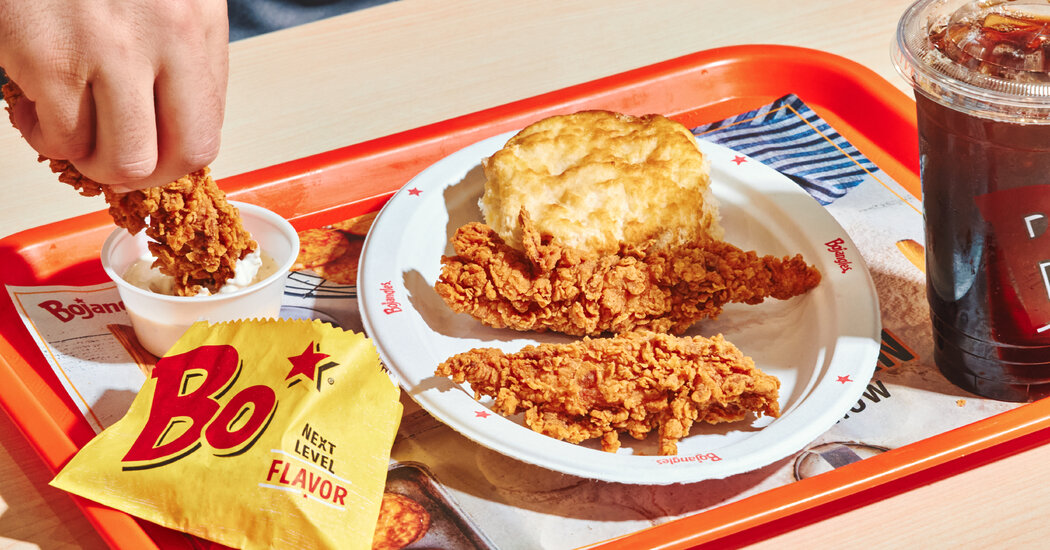
Timothy Williams recently adopted a new Sunday morning routine: On his way to church in Bedford-Stuyvesant, Brooklyn, he makes a detour, driving south to East Flatbush to pick up a chicken-biscuit combo from the fast-food chain Bojangles.
“I’ve been waiting for them to come here,” said Mr. Williams, 34. A native of South Carolina, he heard about the East Flatbush location — the chain’s first stand-alone outpost in the five boroughs — on TikTok and made the pilgrimage the week it opened in mid-January, when Bojangles drew lines of faithful fans hankering for its signature fried chicken, sweet tea and buttermilk biscuits.
“I think once everybody gets hip to it, it’s going to be big.”
The thing is, Bojangles is already big, with nearly 900 locations across 22 states, many of them concentrated from Virginia to northern Florida. (Last year, the company brought in $1.95 billion in revenue, according to a spokeswoman.)
It joins a string of Southern fast-food fried chicken chains to arrive in New York, starting a decade ago with the opening of Chick-fil-A in Midtown Manhattan and continuing through this summer, when Zaxby’s is set to open on the Upper East Side.
“In the United States, it begins with New York,” said José Armario, the chief executive of Bojangles, who was brought on in 2019, in part, to help lead expansion plans. “The brand was very powerful,” he added. “But I didn’t understand why it hadn’t grown outside of its Southern footprint.” New locations are also planned for California, Arizona and Oklahoma.
“I think they’re well-positioned for success,” said Paige Leyden, a director of food and drink at the market research firm Mintel, noting that Southern fast-food companies that specialize in chicken — Popeyes and Raising Cane’s, both from Louisiana, and Chick-fil-A, from Georgia — have primed the area for Bojangles’ arrival. “It’s easier to sell fried chicken because everyone knows it,” she said.
It wasn’t a genteel Southerner or a private equity analyst who ultimately brought Bojangles to New York City, but Habib Hashimi, a first-generation American born and raised on Long Island. Mr. Hashimi, whose parents, immigrants from Afghanistan, owned five Popeyes locations across Brooklyn, signed a deal last year to open 19 more locations over the next decade in New York City and on Long Island, where a second, in Farmingville, is already under construction.
He became aware of the chain not on some heady trip down South, but from a two-page spread in the trade magazine Franchise Times. He submitted an inquiry and was invited to the Bojangles corporate office in Charlotte, N.C., to learn more. There he visited a few locations, met team members and, crucially, tried the food.
“I couldn’t stop talking about it on the flight back to New York,” said Mr. Hashimi, 28. He was impressed, he said, by the fact that the restaurants don’t use microwaves, but cook everything on open stoves.
In addition to fried chicken, Bojangles is also known for its biscuits, which are made from scratch with a proprietary flour mixture, using a much-touted 49-step process. The method is such a point of pride, in fact, that some locations, including the one in East Flatbush, have what they call a “theater,” where customers can watch through a window as an employee mixes and cuts the dough.
This is the latest chapter in New York City’s long relationship with Southern cooking and soul food — and the American South — stretching back to the Great Migration, when Black Southerners opened small, independent businesses to import the flavors of home to their adopted city. But many of those mom-and-pop restaurants, like M & G Diner in Harlem or Carolina Country Kitchen in Bedford-Stuyvesant, have shuttered.
The cookbook author and food consultant Nicole A. Taylor, who splits her time between Bedford-Stuyvesant and her hometown, Athens, Ga., sees fast-food chains as missing a distinct hallmark of that Southern experience: community.
“I think about Peaches Hothouse,” she said, describing a popular restaurant in her Brooklyn neighborhood. “You can literally go in and touch the owners. You can go in for happy hour and see your neighbors, your kid’s teacher. A chain can’t recreate that.”
Bojangles’s push into New York also reflects certain economic realities on both the supply and demand side, she added. After the barbecue boom of the 2000s and 2010s (which may have ended in December with the closing of the critically acclaimed restaurant Fette Sau in Williamsburg), the rise of fried chicken may be, in part, because of its affordability in contrast to beef and other pricier meats.
“I’m all for people having options to feed their families, and I’m all for people having restaurants, even fast-food restaurants, that open up conversations about their roots,” she said, calling Bojangles a favorite even among her “fancy chef friends” from the South. “But we can’t have a Bojangles on every block. I don’t want to see a Chick-fil-A in every neighborhood.”
Mr. Hashimi said he picked East Flatbush, which is predominantly Black, over flashier or heavier-trafficked neighborhoods in Manhattan and Brooklyn for practical reasons: He knew the area well, and the real estate was right — a corner lot with space for a small parking lot and drive-through.
A recent visit to the East Flatbush location demonstrated that while the menu may aspire to a certain romantic version of the South and its cuisine, Bojangles is still, at its core, a fast-food restaurant, catering mostly to grab-and-go customers and, often, delivery drivers. And while the location serves only boneless chicken — no bone-in, which remains a staple elsewhere — it may deliver in terms of nostalgia, especially for Southerners.
Zach Johnson, a college student at Marymount Manhattan College on the Upper East Side, first ate Bojangles chicken at 13, when his family moved to North Carolina. “I fell in love with it,” he said. “Is that dumb to say?” Mr. Johnson, 18, is such a fan that on the wall of his dorm room, in place of the usual markers of identity like indie movie or rock band posters, he has a flattened Bojangles takeout box.
This gloomy Sunday morning, Mr. Johnson had brought his friends — from California, Texas and Wisconsin — to try the food he grew up with and to introduce them to the chain’s vernacular: Chicken nuggets are called Bo Bites, hash browns are Bo-Tato Rounds and blueberry biscuits drizzled with icing are Bo-Berry Biscuits. The company’s unofficial slogan: “It’s Bo Time.”
Cynthia Brown, who lives in the neighborhood and heard about Bojangles from friends, decided to try it after seeing throngs of customers during its opening week. “Oh gosh, it was so packed,” she recalled. “Cars all over the place, and it’s been like that until we had the storm, and then it died down a bit.”
This morning, she ordered a chicken biscuit for herself and a friend waiting at home. When asked why she had chosen Bojangles over competitors, she had a no-nonsense response. “It tastes good,” she said. “And I don’t feel like cooking.”
Follow New York Times Cooking on Instagram, Facebook, YouTube, TikTok and Pinterest. Get regular updates from New York Times Cooking, with recipe suggestions, cooking tips and shopping advice.